Is an Electric Heat Press Worth It for Small Businesses in 2026?
September 30, 2026
As the demand for personalized products continues to grow, more entrepreneurs are launching custom apparel stores, DTF printing services, and home-based businesses. While printing technology has evolved rapidly, one question remains common among new business owners:
Is an electric heat press worth the investment?
For many small businesses, purchasing equipment is one of the biggest startup expenses. Choosing the right heat press directly affects production efficiency, transfer quality, labor costs, and long-term profitability.
In this guide, we’ll compare electric and manual heat press machines, explore their advantages, and help you decide whether upgrading to an electric heat press is the right move for your business in 2026.
Why More Small Businesses Are Choosing Electric Heat Press Machines
Just a few years ago, manual heat presses dominated the market because they were affordable and easy to operate. However, as DTF printing has become one of the fastest-growing decoration methods, production demands have changed significantly.
Today’s customers expect:
- Faster turnaround times
- Consistent print quality
- Better wash durability
- Professional finishing
- Higher production capacity
Meeting these expectations with a manual heat press can become challenging as order volume increases.
Electric heat press machines are designed to solve these problems by providing automated pressure control, stable heating performance, and simplified operation.
For businesses planning long-term growth, investing in an electric heat press machine is becoming less of a luxury and more of a practical business decision.
Manual vs Electric Heat Press: What’s the Difference?
Both machines apply heat and pressure to transfer designs onto garments or other materials, but the way they generate pressure is completely different.
Manual heat presses rely on the operator to pull the handle and adjust pressure manually. The final transfer quality depends largely on the user’s experience and physical consistency.
Electric heat press machines automate the pressing process. With one-touch operation, the machine applies consistent pressure every cycle, reducing human error and improving production stability.
Manual Heat Press
Advantages
- Lower initial investment
- Simple mechanical structure
- Suitable for hobby users
Limitations
- Pressure varies between operators
- Operator fatigue during long production runs
- Less consistent transfer quality
- Slower production speed
Electric Heat Press
Advantages
- Automatic pressure application
- Consistent transfer quality
- Less physical effort
- Faster workflow
- Higher production efficiency
- Better repeatability
For businesses processing dozens or hundreds of garments every day, these advantages can significantly improve overall productivity.
How Automatic Pressure Improves DTF Printing
DTF printing relies heavily on accurate pressure during the transfer process.
Unlike some traditional heat transfer methods, DTF adhesive powder requires stable and even pressure to fully bond with the fabric.
If pressure is inconsistent, problems such as these may occur:
- Poor edge adhesion
- Incomplete transfers
- Peeling after washing
- Uneven color appearance
- Reduced durability
An electric heat press eliminates much of this variability.
Because the pressure is automatically controlled, every transfer receives the same pressing force, helping businesses achieve repeatable, professional-quality results.
This consistency is especially valuable when producing bulk orders for customers.
Better Efficiency Means Higher Profitability
Time is one of the most valuable resources for any small business.
With a manual heat press, every pressing cycle requires the operator to:
- Position the garment
- Pull the handle
- Apply force
- Hold pressure
- Release manually
After hundreds of transfers, this repetitive motion becomes tiring.
An electric heat press simplifies the process.
With one-touch operation, the machine automatically completes the pressing cycle, allowing operators to focus on preparing the next garment or managing other production tasks.
Over time, the labor savings can significantly increase overall productivity.
Consistent Quality Builds Customer Trust
For businesses selling custom apparel online, consistency is critical.
Customers expect every order to match previous purchases.
Inconsistent pressure can lead to noticeable differences between products, increasing customer complaints and return rates.
Electric heat presses help standardize production by delivering:
- Stable pressure
- Even heating
- Accurate timing
- Repeatable transfer results
Reliable production quality helps businesses build stronger customer satisfaction and long-term brand reputation.
Is the Higher Investment Worth It?
One of the biggest concerns for new businesses is equipment cost.
Although an electric heat press usually costs more than a manual model, the long-term value often outweighs the higher initial investment.
An electric machine can help reduce:
- Labor costs
- Production errors
- Material waste
- Rework time
- Operator fatigue
Meanwhile, it improves:
- Production efficiency
- Transfer consistency
- Product durability
- Customer satisfaction
- Business scalability
For businesses expecting regular DTF production, these advantages often provide a faster return on investment (ROI).
Who Should Choose an Electric Heat Press?
An electric heat press is particularly suitable for:
- DTF printing businesses
- Small apparel brands
- Print-on-demand sellers
- Etsy shop owners
- Promotional product suppliers
- Home-based entrepreneurs
- Growing custom printing businesses
If your production volume is increasing or you plan to expand in the future, an electric heat press can help support that growth.
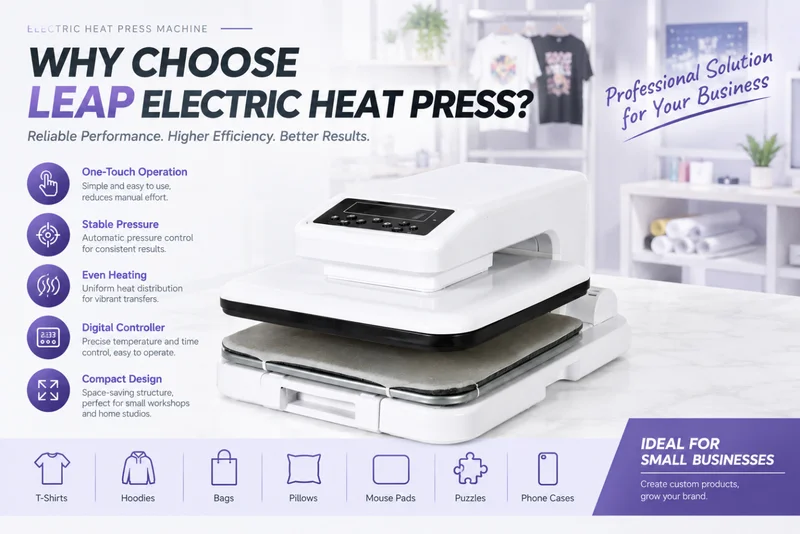
Why Choose the Taile LEAP Electric Heat Press?
Designed specifically for modern heat transfer applications, the Taile LEAP Electric Heat Press combines intelligent operation with reliable performance to help businesses improve productivity without sacrificing quality.
One-Touch Operation
The automatic pressing system simplifies daily operation, reducing manual effort and increasing production efficiency.
Stable Pressure
Consistent pressure ensures reliable DTF transfers, improving adhesion and long-term durability.
Even Heating
Uniform heat distribution helps achieve vibrant colors and consistent transfer performance across the entire platen.
Digital Controller
The intuitive digital control panel allows precise adjustment of temperature and time, making operation straightforward for both beginners and experienced users.
Compact Design
Its space-saving structure makes the LEAP an excellent choice for home studios, small workshops, and growing businesses where workspace is limited.
Built for Small Businesses
Whether you’re launching a custom apparel brand or expanding an existing DTF workshop, the LEAP Electric Heat Press offers professional performance with user-friendly operation, making it an ideal investment for businesses looking to improve efficiency and consistency.
Conclusion
As personalized printing continues to expand in 2026, production efficiency and consistent quality have become more important than ever.
While manual heat presses remain suitable for occasional use or hobby projects, businesses looking to grow can benefit significantly from upgrading to an electric heat press.
With automatic pressure control, one-touch operation, stable heating, and improved productivity, an electric heat press machine helps reduce labor, improve transfer quality, and support long-term business success.
If you’re planning to expand your DTF printing business or upgrade your production workflow, the Taile LEAP Electric Heat Press offers a dependable solution designed to meet the demands of today’s custom printing industry.